
Licence CC BY-NC-ND, Thierry Parmentelat - (images courtesy of wikipedia)
pentominoes and exact cover#
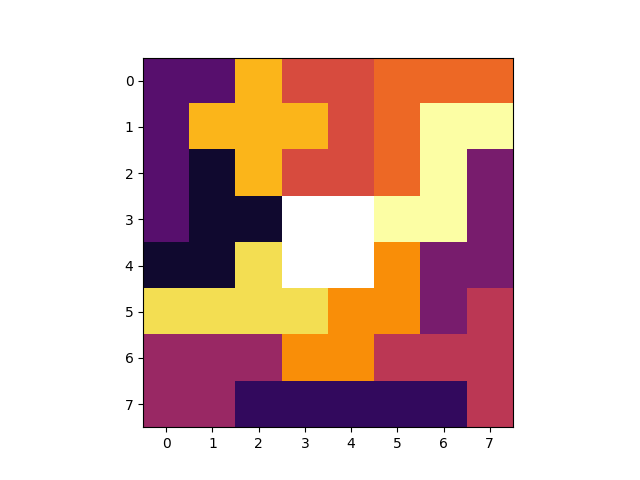
this activity is about solving puzzles like the one pictured on the right, using a standard combinatorial algorithm
download the zip
in order to work on this exercise from your laptop, start with downloading the zip
the exact cover problem#
an example#
in a nutshell, the exact cover problem is a standard, very basic mathematical problem; let’s start with an example
you feed the algorithm with a set of vectors that all have the same length, and contain 0 and 1, like e.g.
0:  (1 0 0 1 1 0 1 0)
1:  (1 0 0 0 1 1 0 1)
2:  (1 0 0 0 1 1 1 0)
3:  (1 0 1 0 1 1 0 0)
4:  (1 0 0 0 1 0 1 1)
5:  (1 0 1 1 1 0 0 0)
6:  (1 0 0 0 0 1 1 1)
7:  (0 1 0 1 1 0 1 0)
8:  (0 1 0 0 1 1 0 1)
9:  (0 1 0 0 1 1 1 0)
10: (0 1 1 0 1 1 0 0)
11: (0 1 0 0 1 0 1 1)
12: (0 1 1 1 1 0 0 0)
13: (0 1 0 0 0 1 1 1)
and the goal is to find a subset of the input vectors, such that each column of the input is covered exactly once
(of course there is the accessory question about whether there are several
solutions, but let’s not dwelve into that, for now at least..)
so in the above example, there would be 2 solutions, namely
# a solution has exactly one 1 in each column

5:  (1 0 1 1 1 0 0 0)
13: (0 1 0 0 0 1 1 1)
and
6:  (1 0 0 0 0 1 1 1)
12: (0 1 1 1 1 0 0 0)
the algorithm and its implementation in Python#
one possible way to solve this problem has been the subject of a famous article by Donald Knuth - one of
the fathers of Computer Science - and is known as Knuth’s Algorithm X - interested students can find more details in the links section below.
we’re not going to go into the details of the algorithm either, but rather focus
on the application to solving pentominoes (see next section)
let us just outline that
Algorithm X, also known as dancing links, is an extremely efficient implementation for solving the exact cover problem
and fortunately for us, there are several Python implementations of it (see pypi.org for details):
xcoverexact-coverexact-cover-py
So your first task is to search for one of these packages (xcover seems the most efficient one),
install it, and read the basics about how to use it
application to pentominoes#
the pentominoes#
and now for something completely different…
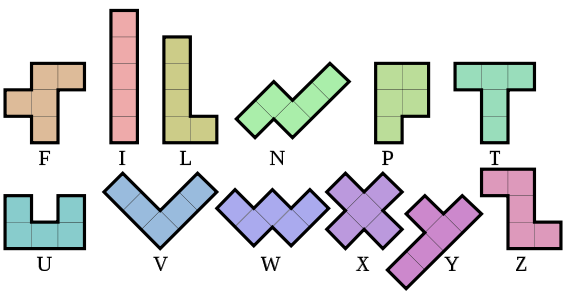
the pentaminoes are the 12 patterns that can be made of 5 contiguous squares - modulo rotations and symmetry
they have been given names, letters actually:
some standard problems#
they can be taken as the pieces of a puzzle, and so the standard problems are to fill shapes with these 12 pieces - of course each piece is to be used exactly once, in any rotation / symmetry
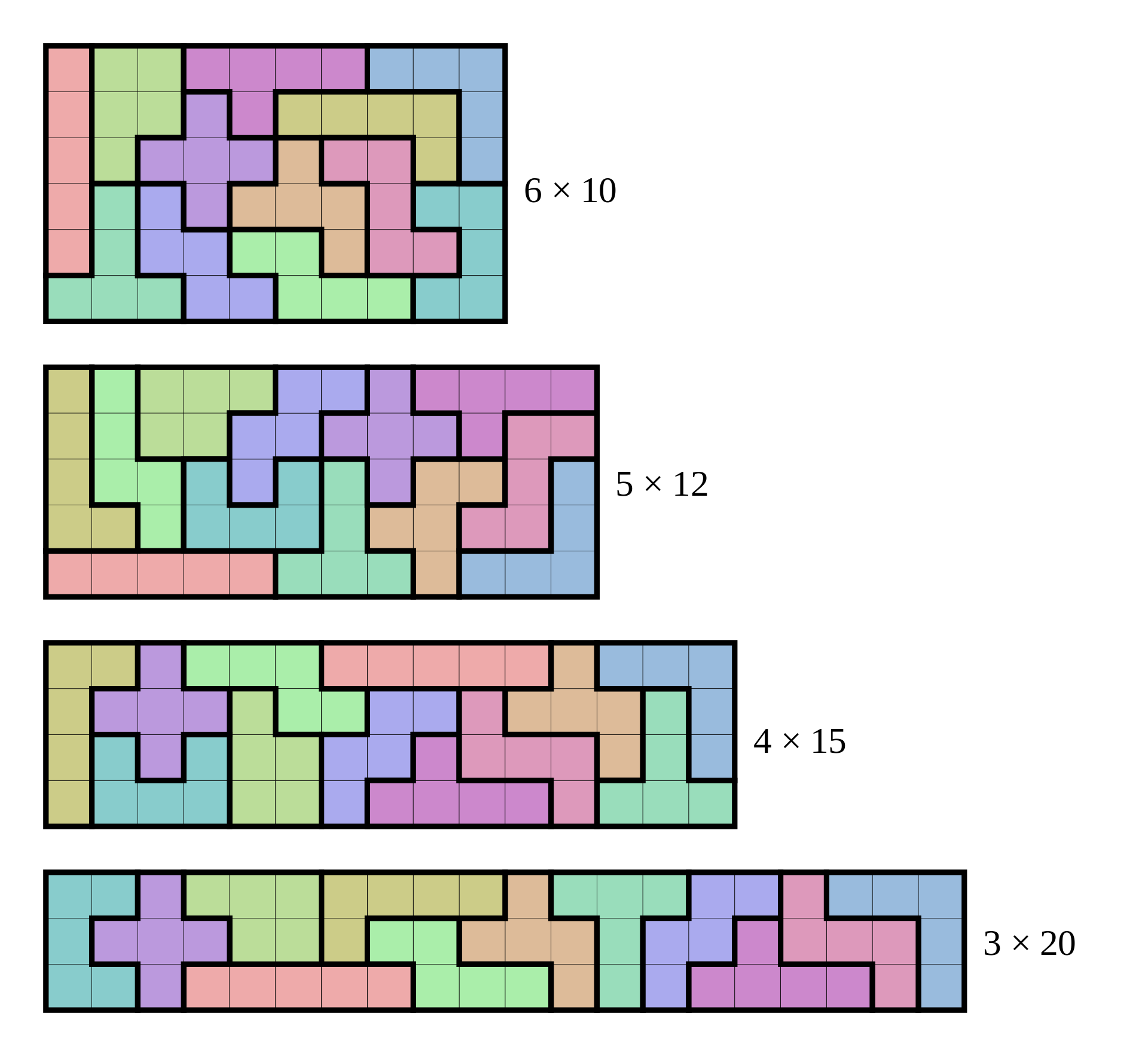
we’ll consider here the following shapes (of course each shape must have an area of \(12 * 5 = 60\))
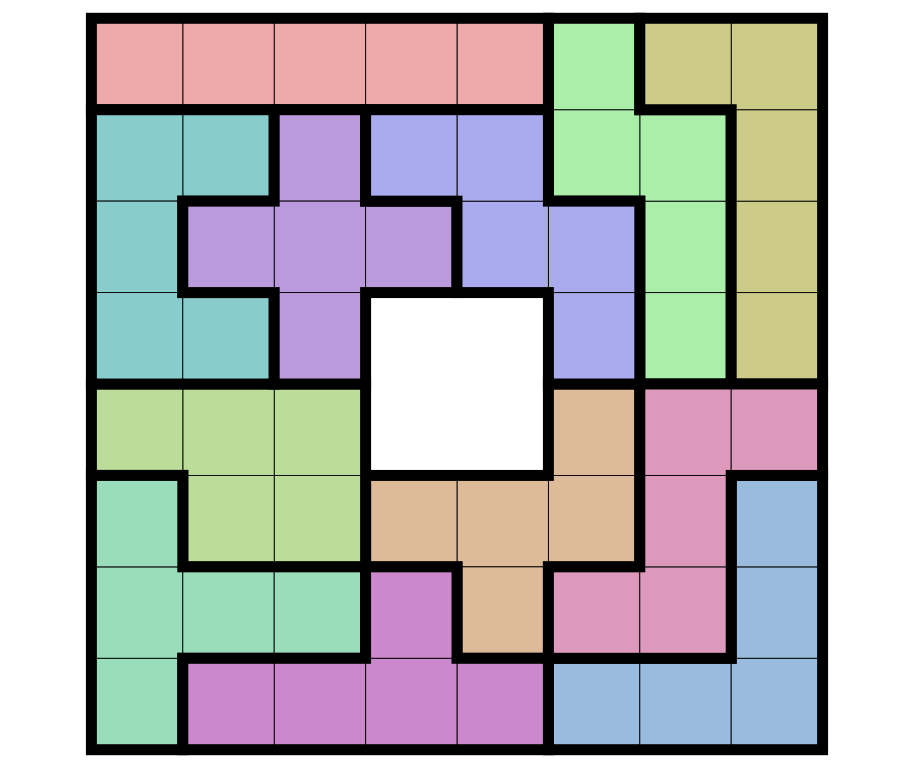
as well as this one within a 8x8 square and a hole inside
how to solve such a problem#
the trick is to transform the puzzle problem into an exact cover problem
there are many resources on the Internet that explain how to do that - and feel free to use them too
on our end, let’s consider a smaller problem as depicted ; note that the white squares are holes, and of course not part of the problem
our small example#
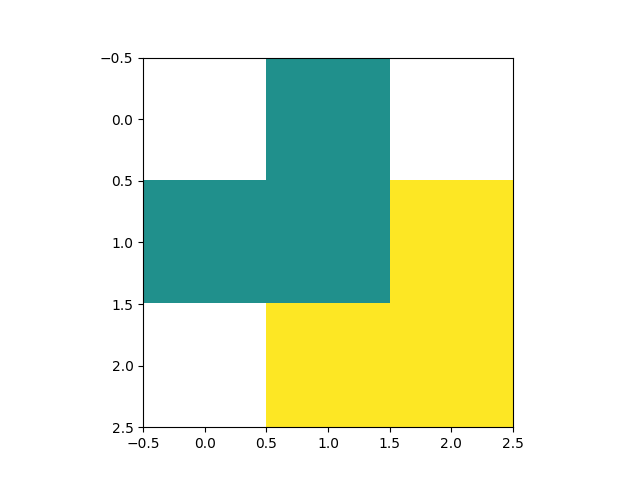
it turns out this problem can be mapped to the sample input quoted above in the introduction, i.e.
0:  (1 0   0 1 1 0 1 0)
1:  (1 0   0 0 1 1 0 1)
2:  (1 0   0 0 1 1 1 0)
3:  (1 0   1 0 1 1 0 0)
4:  (1 0   0 0 1 0 1 1)
5:  (1 0   1 1 1 0 0 0)
6:  (1 0   0 0 0 1 1 1)

7:  (0 1   0 1 1 0 1 0)
8:  (0 1   0 0 1 1 0 1)
9:  (0 1   0 0 1 1 1 0)
10: (0 1   1 0 1 1 0 0)
11: (0 1   0 0 1 0 1 1)
12: (0 1   1 1 1 0 0 0)
13: (0 1   0 0 0 1 1 1)
how is this obtained ?#
you will find one line for each possible position of a piece on the board
this line will contain:
the first 2 columns (we have 2 pieces) correspond to the piece number
we set exactly one 1 to indicate which piece we’re talking about
so for example the first 7 rows correspond to the 7 positions where we can place piece#0because there are 6 squares to be filled, the next 6 columns correspond to the slots that the piece in that position would occupy
(1 means the slot is occupied)
and since the 2 pieces are identical, the 7 last rows carry the same information, but for piece#1
note
obstacles (the white squares) in the board must not be given a column:
there would be only 0’s in that column, and exact_cover would find no solution
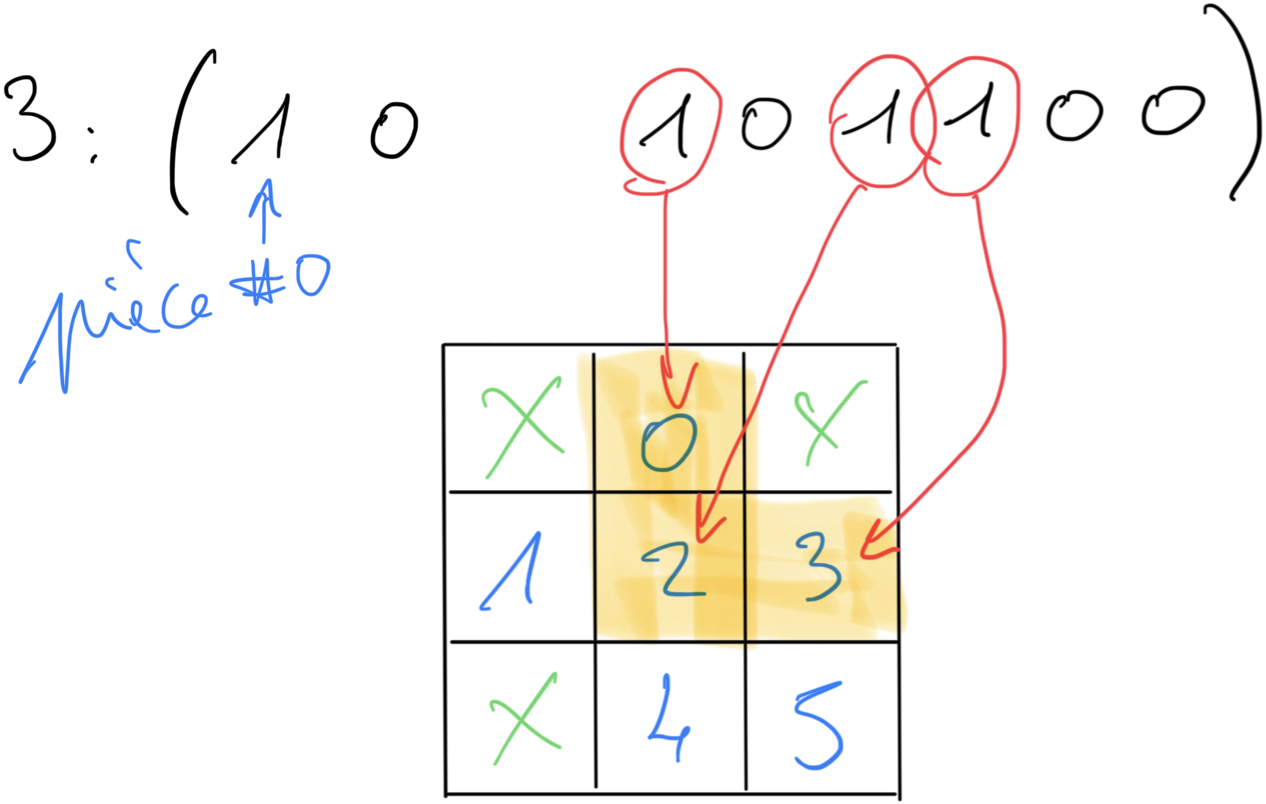
and so for example with our small problem, the line 3: means:
this is about piece#0 (hence col0=1 and col1=0)
and that piece may be placed on the board in the following position
X o X
. o o
X . .
which, once you remove the obstacles, and flatten, reads 1 0 1 1 0 0: the right-hand-side of first line
how to read a solution ?#
if you pick xcover as a solver engine, it will expose a generator over solutions; this means that you can wrote something like
solutions = covers_bool(problem)
first = next(solutions)
print(first)
-> [5, 13]
which maps to the following rows into the input problem:
5:  (1 0   1 1 1 0 0 0)
13: (0 1   0 0 0 1 1 1)
which we then interpret, the other way around, like so:
there is at least one solution to the problem
and in this solution we have piece#0 that spans these locations
X o X
o o .    (because 111000 for piece #0)
X . .
and piece#1 that spans these locations
X . X
. . o    (because 000111 for piece #1)
X o o
quiz#
how many columns are you going to need for a real-scale pentaminos problem ?
solution
you have 12 pieces and 60 slots to fill, so you need 72 columns
what to do#
model the problem#
decide how to represent the board and pieces:
using nd-arrays, so rectangular spaces
use only booleans to model obstacles in the board and the actual contour of pieces
you will find some helper code in pentominos_data.py if you wish to use it
in particular, note the presence of SMALL_BOARD and SMALL_PIECE
that correspond to the following solution, and that may turn out useful for debugging your code
rotations and symmetries#
for each piece, compute its - possibly up to 8 - variants
compute all possible translations#
for each piece (supposed to have been rotated and/or swapped already) compute all the possible locations on the board
prepare the exact_cover input#
given a board and a set of pieces, compute the input to covers_bool()
pretty-print a solution#
your solver will then compute one solution (if there’s one, of course)
from this solution, your job is to compute a ‘pretty’ view of the solution, something like e.g.
(( 3  3  6  7  7  5  5  5 11 11 11 11)
 ( 3  6  6  6  7  9  5  5 10 11 12 12)
 ( 3  1  6  7  7  9  9 10 10 10 12  8)
 ( 3  1  1  4  4  4  9  9 10 12 12  8)
 ( 1  1  4  4  2  2  2  2  2  8  8  8))
or, in the case where there are ‘obstacles’ on the board, it could be something like this (use 0 for the holes)
(( 2  7  7  6 11 11 11 11)
 ( 2  7  6  6  6 10 11  4)
 ( 2  7  7  6 10 10 10  4)
 ( 2  5  5  0  0 10  4  4)
 ( 2  5  5  0  0  1  4  3)
 ( 8 12  5  1  1  1  9  3)
 ( 8 12 12 12  1  9  9  3)
 ( 8  8  8 12  9  9  3  3))
matplotlib#
if time permits, you could also transform this rough numpy solution into a nicer matplotlib drawing - or any other visual library of your choice, like e.g.
hints
to produce this we have
used some predefined colormaps in matplotlib - see
matplotlib.pyplot.colormaps()- you could consider accepting an argument that specifies one if themmade the (color corresponding to) obstables transparent, by using the so-called alpha channel (fourth if you count first the red, green and blue channels)
# import matplotlib
# matplotlib.pyplot.colormaps()
testing#
you should find at least one solution for
rectangle 6x10
rectangle 5x12
rectangle 4x15
rectangle 3x20
rectangle 8x8 with a 2x2 obstacle in the middle
2 rectangles 5x6
… and many more of course, like e.g.
BOARD_8_9inpentominos_data
what now ?#
further applications#
you can use exact_cover to solve a whole range of other problems, like for example sudoku - and it’s actually less obvious to do the mapping; if you’re done early you can give these some thought
links#
if you plan on going (much) further, and on implementing a solver yourself, make sure to read this step-by-step description of the algorithm (you need several hours/days to get through this ;):”The art of computer programming”, section 7.2.2.1